
Should You Remodel Your Kitchen Before Selling Your Phoenix Home?
⚡ Quick Answer
Whether you should remodel your kitchen before selling depends on three factors: your price tier, the current condition of your kitchen, and how much time you have before listing. In Phoenix, mid-range homes priced between $400K and $700K benefit most from a pre-sale cosmetic refresh — not a full gut renovation. Homes in Scottsdale, Paradise Valley, or North Phoenix luxury corridors face higher buyer expectations and may warrant more substantial investment. A full remodel is rarely necessary for resale purposes alone and rarely recovers its full cost at closing.
You have a listing date in mind, or a realtor has nudged the conversation toward it. And now you are sitting with a question that feels simple but is not: do I put money into this kitchen before I sell?
The wrong answer costs you. Say yes when you should have said no, and you have spent $60,000 on a renovation that closes in a $22,000 price bump. Say no when you should have said yes, and you hand your buyer a $30,000 credit because your kitchen gave them leverage they used at the table.
I have walked through enough Phoenix listings — and done enough kitchens in Scottsdale, Chandler, Tempe, and central Phoenix — to know that the right answer depends on variables most general advice ignores. This article gives you a decision framework that actually accounts for them: your price tier, your kitchen’s condition, and your timeline before listing.
If you want to understand the full ROI picture before getting into the sell-or-stay decision, start with our kitchen remodel ROI guide for Phoenix — it covers exactly what the data shows for each scope tier. Then come back here for the decision logic.
What the Research Says About Pre-Sale Kitchen Remodels
Homes.com published a thorough look at this exact question — should you remodel your kitchen before selling your home? — and the findings are more nuanced than most homeowners expect.
The headline finding: ROI on kitchen remodels ranges from 38% to 96% depending on the scope of the project. That is a massive range. A minor cosmetic remodel can return close to the full project cost. A complete gut renovation at $100,000+ typically returns less than half.
Beverly Parkinson, an LA-based interior designer who stages homes for sale, explained the split clearly: for mid-market homes, a cosmetic facelift is typically sufficient. For luxury properties, the calculus changes. “In high-end homes,” she told Homes.com, “a dated kitchen often requires a full renovation to meet buyer expectations. That’s a bigger investment but necessary to realize a return on investment in that tier.”
The National Kitchen and Bath Association adds another layer. In their 2026 Trends Report, more than 70% of the 634 designers surveyed said transitional and timeless styles are the top kitchen priority — meaning buyers are not chasing flashy; they are looking for kitchens that feel current without feeling trendy. That is a meaningful constraint on how much you need to spend to satisfy them.
The takeaway: the research does not say “yes, remodel” or “no, skip it.” It says the right answer depends on where your home sits in the market and what condition your kitchen is actually in. Let’s apply that to Phoenix specifically.
The Phoenix Market Reality in 2026
Phoenix metro inventory has increased significantly over the past 18 months. The market that was effectively seller-controlled through 2022 has moved toward balance — and in some submarkets, toward buyer advantage. More listings mean buyers have more options, more time to compare, and more leverage when they find a reason to negotiate.
Average days on market across Phoenix-area submarkets is running approximately 58 to 65 days for non-distressed residential listings. That is not a buyer frenzy market. Homes that need work are sitting longer, getting toured with a skeptical eye, and generating offers with kitchen-related credits baked in.
The practical effect for sellers: a dated kitchen is no longer something buyers shrug at. In a balanced market, it becomes an invitation to negotiate. Buyers will either pass on the showing entirely after seeing listing photos, or they will show up with a number already in their head for what it will cost them to fix it. Either way, you are giving up leverage you could have kept.
Move-in-ready kitchens — particularly in the $400K to $700K mid-range where the Phoenix market is most competitive — sell with less friction, fewer concession demands, and shorter time on market. The math in a balanced market often favors a targeted pre-sale investment in ways it didn’t need to when everything was selling in 48 hours regardless.
Scottsdale, Paradise Valley, and the luxury corridors of North Phoenix operate differently. Buyer expectations there start higher and the competitive set is tighter. An $800K to $1.5M listing with a kitchen that hasn’t been touched since 2010 is not just dated — it’s a reason for buyers to walk.
The Three-Scenario Framework: Which Situation Is Yours?
Rather than a blanket yes or no, here is a practical decision matrix based on kitchen condition. Most Phoenix sellers fall into one of three scenarios.
Scenario A: Functional but Dated (Kitchen is 10–18 years old, everything works, nothing is broken)
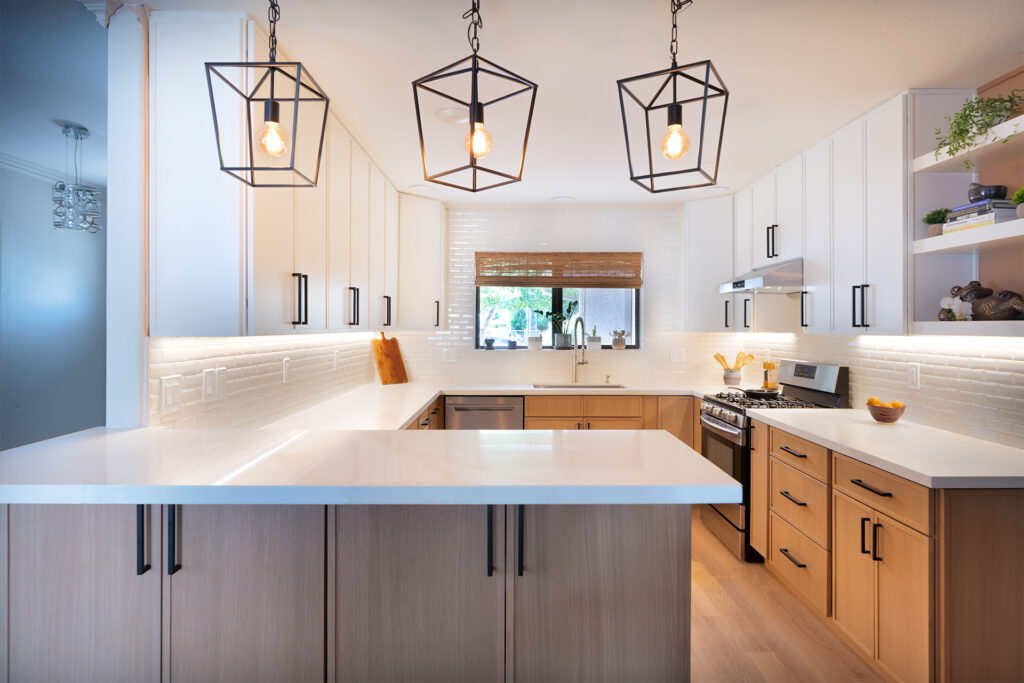
Recommendation: Cosmetic refresh — yes. This is the highest-ROI scenario. Your cabinets are likely solid. Your layout works. What's failing is the visual impression: outdated hardware, dull surfaces, old lighting. A targeted cosmetic refresh — hardware, lighting, countertops, possibly backsplash — costs $12,000 to $28,000 in Phoenix and returns well above the national average for minor remodels. You are not rebuilding the kitchen. You are removing the reasons a buyer negotiates against you.
Scenario B: Visually Failing (Laminate countertops, broken or missing hardware, stained or warped surfaces, mismatched appliances)
Recommendation: Mid-range refresh — necessary, not optional. A kitchen in this condition is actively costing you at listing. Buyers are not pricing in the cost of minor improvements; they are pricing in the disruption of living through a renovation and adding a margin on top of that. A mid-range refresh — new cabinet fronts or refacing, quartz countertops, updated appliances, new lighting — runs $30,000 to $55,000 in Phoenix. Skipping it in favor of a price reduction almost never pencils out in the seller's favor.
Scenario C: Full Gut Situation (Requires structural changes, plumbing relocation, full cabinet replacement)
Recommendation: Get a contractor assessment before committing. This is where the Homes.com ROI data is most relevant — a complete remodel returns 38% to 50% nationally. In most Phoenix mid-range homes, the math does not support a full gut renovation for resale purposes alone. The exception is luxury: if your home is priced above $900K and your kitchen is a genuine liability, a full renovation may be necessary to compete. Even then, get a realistic estimate of value uplift from a listing agent before authorizing the spend.
What a Pre-Sale Kitchen Refresh Typically Includes in Phoenix
For Scenario A and most Scenario B homes, the pre-sale refresh follows a consistent scope. These are the upgrades that move the needle with buyers without triggering the cost and timeline of a full renovation.
| Upgrade | What It Addresses | Typical Phoenix Cost |
|---|---|---|
| Cabinet paint or refinishing | Eliminates dated color and worn finish without replacing boxes | $2,500–$5,500 |
| Hardware replacement | Pulls, hinges, faucet — the fastest visual transformation per dollar | $400–$1,200 |
| Countertop refresh | Quartz replacement or reskin; removes the biggest visual liability in most dated kitchens | $3,500–$9,000 |
| Backsplash | New tile or slab backsplash; completes the countertop update visually | $1,200–$3,500 |
| Lighting | Pendant replacement, under-cabinet LED, recessed refresh | $1,500–$4,000 |
| Full cosmetic package (combined) | All of the above as a coordinated scope | $12,000–$28,000 |
Beverly Parkinson’s observation from Homes.com captures why hardware deserves special mention: “Changing a knob is like witchcraft — it transforms the whole kitchen. Hardware is the jewelry of the space.” It is the highest ROI-per-dollar upgrade in any pre-sale scope. If budget is genuinely constrained, start there and work outward.
Not sure what scope makes sense for your kitchen? Use the Artisan Estimator to get a ballpark cost for your specific situation — before you commit to a contractor conversation.
The ROI Math for Phoenix Sellers: Refresh vs. Credit vs. Price Reduction
Here is the comparison that most sellers never actually run — and should.
Assume a Phoenix home priced at $550,000. The kitchen is Scenario A: functional, dated, needs a cosmetic refresh.
| Option | Upfront Cost | Likely Outcome | Net Position |
|---|---|---|---|
| Do a cosmetic refresh | $18,000–$22,000 | List at $550K, reduce buyer negotiation leverage, sell closer to ask | Recover $18K–$30K in avoided concessions; net neutral to positive |
| Skip it, price at market | $0 upfront | Buyers use dated kitchen to negotiate; typical credit demand of $20K–$35K | Net negative vs. refresh scenario |
| Full gut renovation | $70,000–$95,000 | Best-case $35K–$50K in value uplift at $550K price tier | Net negative — overspent for the price tier |
The data from our kitchen remodel ROI guide reinforces this: minor cosmetic remodels return 90%–113% nationally. A full gut at $80,000+ returns 36%–51%. The cosmetic refresh is not just the most affordable option for a pre-sale scenario — it is the most financially sound one.
The full renovation almost never makes sense as a resale-only investment in the mid-range Phoenix market. The homes where it makes financial sense are at the top of the price tier — $900K and above — where buyer expectations are high enough and the value ceiling is wide enough to absorb the spend.
When You Should NOT Remodel Before Selling
The framework above favors a pre-sale refresh in most Scenario A and B situations. But there are clear cases where you should skip it entirely and focus your energy elsewhere.
Your closing timeline is under 45 days. A cosmetic refresh done correctly takes 3–6 weeks from contract to completion. Rushing construction into a listing timeline is a recipe for incomplete finishes, triggered inspection issues, and contractor stress you do not need. If you are 30 days from listing, clean, declutter, and stage instead.
The Phoenix market is moving fast in your specific submarket. In a hot seller’s market — multiple offers within days of listing — a dated kitchen is a smaller liability. Check current days-on-market data in your zip code with your agent before authorizing any spend. The balanced market picture described above applies broadly to Phoenix metro, but individual neighborhoods still vary.
Your kitchen’s condition is genuinely acceptable. Updated within the last 8 to 10 years with functional surfaces, working hardware, and reasonably current finishes? Clean it aggressively, stage it intentionally, and let it be. Not every kitchen needs a pre-sale investment.
Your budget is constrained and the home is already priced at the low end of the market. A cosmetic spend on a home priced at the bottom of its range for reasons unrelated to the kitchen rarely moves the needle enough to justify the investment. Focus on price positioning rather than renovation spend in that scenario.
A Realistic Timeline Before You List
Homes.com notes that a full kitchen remodel can take up to six months. Beverly Parkinson’s guidance aligns with what we see in Phoenix: quality contractors are in demand, and timelines that look generous on paper compress quickly when material lead times and scheduling realities hit.
Here is a realistic pre-sale timeline framework for Phoenix homeowners:
| Scope | Construction Timeline | Recommended Lead Time Before Listing |
|---|---|---|
| Hardware + lighting only | 1–3 days | 2–3 weeks (procurement lead time) |
| Full cosmetic refresh (Scenario A) | 2–4 weeks | 6–10 weeks minimum |
| Mid-range refresh with cabinet refacing (Scenario B) | 4–7 weeks | 10–16 weeks minimum |
| Full renovation (Scenario C) | 3–5 months | 5–7 months minimum |
Quality Phoenix contractors in 2026 are booking 6–10 weeks out for most kitchen scopes. If your target listing date is September, you need to be having contractor conversations now — not in August.
The Pre-Sale Kitchen Decision Checklist
Before committing to any scope — or deciding to skip a refresh entirely — work through these questions. This is the same framework we use during consultations with Phoenix sellers.
PRE-SALE KITCHEN DECISION CHECKLIST